Course Description:
- It is a comprehensive, industry-focused program designed to take you from the fundamentals of image processing to the latest advancements in deep learning and neural architectures
- This course provides a complete learning journey that starts with understanding how images are formed, processed, and analyzed using classical computer vision techniques, then transitions into modern deep learning approaches such as Convolutional Neural Networks (CNNs), Transformers, and Generative Models
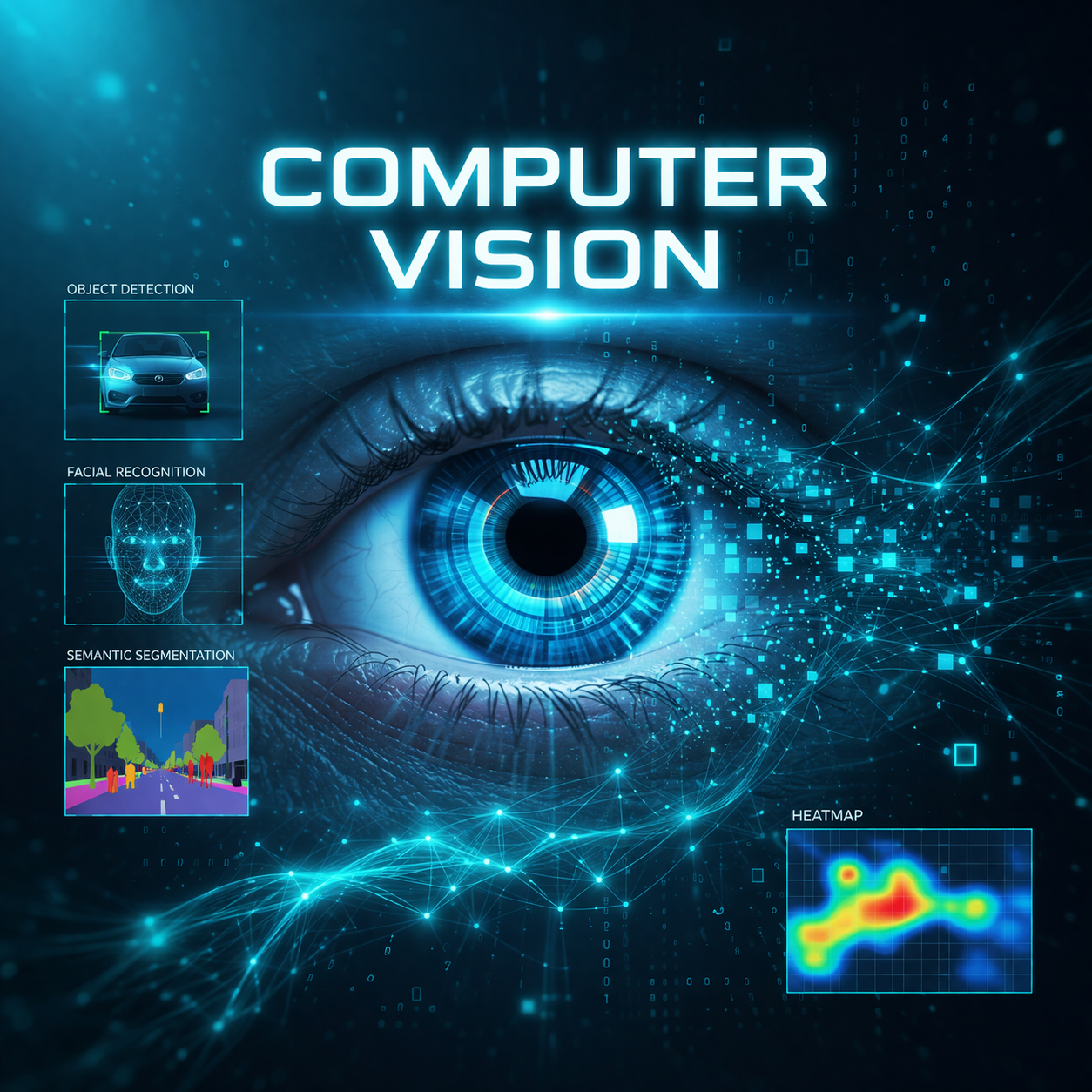
- Through a balance of theoretical foundations and hands-on implementation, you will gain the skills to build intelligent vision systems capable of solving real-world problems such as object detection, image segmentation, facial recognition, and AI-generated content
Course main points:
- > Foundations of Image Processing
- Image formation, camera models, and color spaces
- Image representation and digital image structure
- Edge detection and sampling techniques
- > Feature Detection & Computer Vision Techniques:
- Corner, edge, and blob detection
- SIFT, SURF, and feature descriptors
- Image segmentation and region analysis
- > Feature Matching & Image Representation:
- Feature matching and RANSAC
- Hough Transform for shape detection
- Image retrieval and similarity measurement
- > Neural Networks Fundamentals:
- Introduction to deep learning concepts
- Feedforward neural networks & backpropagation
- Regularization and overfitting control
- > Convolutional Neural Networks (CNNs):
- CNN architecture and design principles
- Popular models: AlexNet, VGG, ResNet, EfficientNet
- Training strategies and transfer learning
- > Computer Vision Applications:
- Object detection (YOLO, Faster R-CNN)
- Face recognition and human analysis
- Medical imaging and real-world applications
- > Sequential Models & Attention Mechanisms:
- Recurrent Neural Networks (RNNs, LSTM, GRU)
- Transformers and Vision Transformers (ViT)
- > Generative Deep Learning Models:
- Generative Adversarial Networks (GANs)
- Diffusion models and modern generative techniques
- > Advanced Topics in AI & Vision:
- Few-shot and zero-shot learning
- Self-supervised learning
- Neural Architecture Search (NAS)
Prerequisites:
- – Programming:
- Proficiency in Python, including NumPy & familiarity with deep learning frameworks (PyTorch or TensorFlow)
- – Linear Algebra:
- Mastery of matrix operations, vector spaces, and eigenvalues/eigenvectors
- – Calculus:
- Strong grasp of multivariate calculus, partial derivatives, and optimization techniques
- – Statistics:
- Solid foundation in probability theory, distributions, and statistical inference
Duration:
100 Hrs
Get Quick Support
Request a Call Back
Ready to explore how artificial intelligence can revolutionise your business operations and unlock new efficiencies? ACTAIA is here to guide you through every step of the transformation journey.
